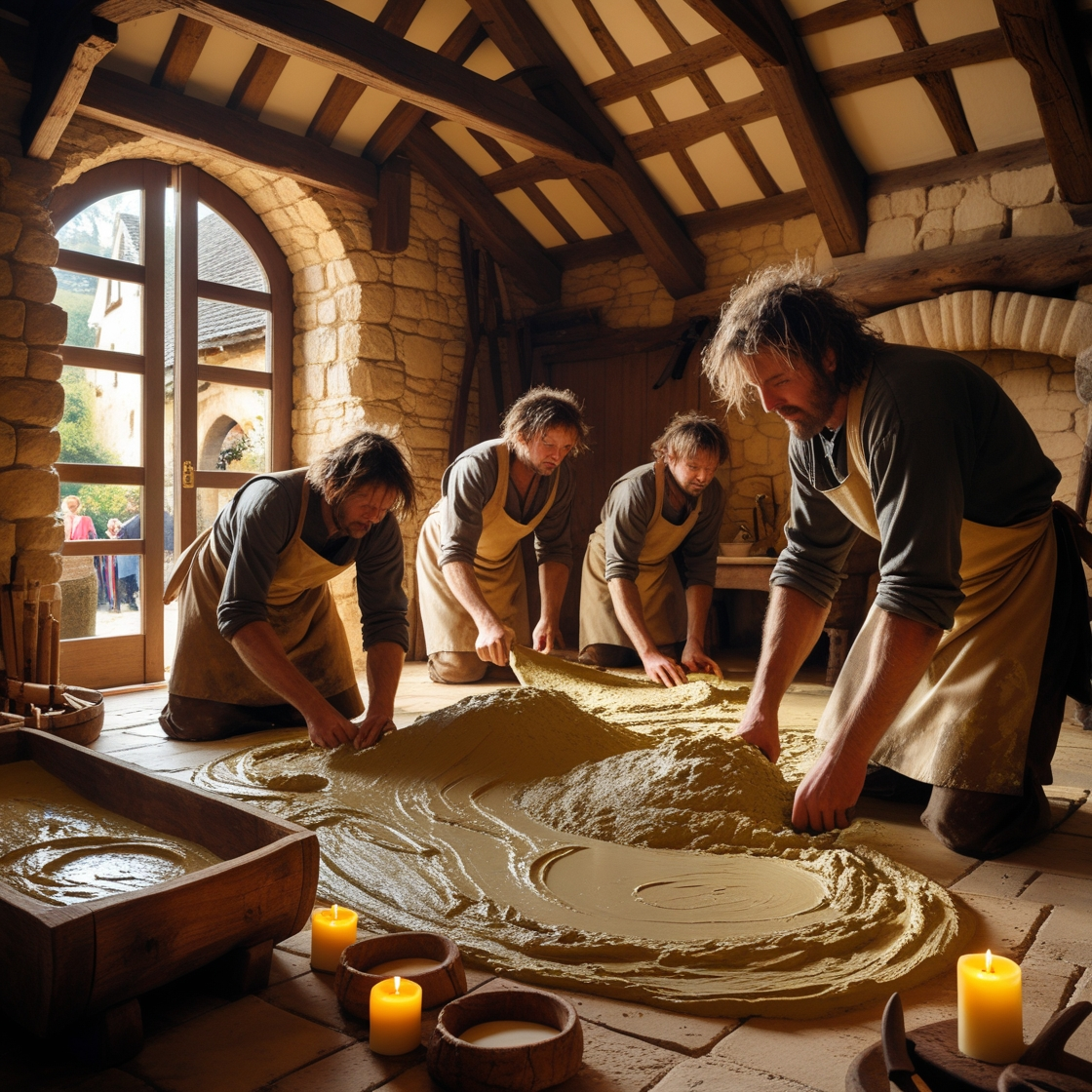
The medieval methodology of creating a lime ash ground would start with excavating and compressing earth beneath it after which following it with a thick base of crushed stone or chalk laid to enhance drainage and structural integrity. Over this may be laid a mix of well-sieved wooden ash and lime ash paste made by burning limestone after which including water to it to type a sort of putty, to which horse or different animal hairs may be added to stop it splitting after which being leveled and completed with a trowel and allowed to slowly harden and dry to type a water-proof and comparatively sturdy flooring floor at an affordable value under both stone or tile flooring.
Lime-ash flooring have been a preferred function in medieval homes, notably in areas the place timber was considerable and stone was costly or troublesome to acquire. These flooring have been valued for his or her sturdiness, ease of building, and insulating properties.
Making and putting in lime-ash flooring was a labor-intensive course of that required data of fundamental building strategies and an understanding of pure supplies. The method mixed lime, sand, and ash, with a layer of wooden or straw for added insulation and luxury.
To create lime-ash flooring, staff sometimes started by getting ready the muse, which regularly concerned leveling the bottom or a wood subfloor. The lime and ash combination was then unfold throughout the ground space, adopted by a compaction course of to make sure the combination settled firmly.
The ground was then left to treatment over time, permitting the lime to harden and bind the supplies collectively. As soon as set, the ground was smoothed and polished, usually handled with wax or oil to enhance its look and longevity.
Now, let’s delve deeper into the detailed course of of creating and putting in lime-ash flooring in medieval homes.

1. Supplies Wanted for Lime-Ash Flooring
The creation of lime-ash flooring concerned easy however efficient supplies that have been available in most medieval areas. The first parts included:
- Lime: Lime was the important thing ingredient for binding the supplies collectively. It was obtained by heating limestone in a kiln to create quicklime (calcium oxide). This was then slaked by including water, forming hydrated lime (calcium hydroxide), which was combined with ash and sand to create the ground combination.
- Ash: Ash, usually from burnt wooden, was used for its light-weight and insulating properties. The ash might come from quite a lot of woods, however hardwood ash was notably favored attributable to its greater high quality and extra constant texture. Ash not solely added bulk to the combination but additionally contributed to the ground’s general stability.
- Sand: Sand was used so as to add texture to the ground combination, stopping it from being too gentle or crumbly. It additionally helped to distribute the warmth evenly throughout the ground, enhancing thermal insulation in chilly climates.
- Water: Water was required to combine the lime and ash right into a workable paste. The correct quantity of water was essential for guaranteeing the combination had the right consistency for compaction.
- Subfloor Supplies (Non-obligatory): In some circumstances, a wood subfloor or a layer of straw or hay was used for insulation, particularly in houses with grime flooring. This layer helped to offer added heat and a secure base for the lime-ash combination.
2. Making ready the Ground House
Earlier than laying the lime-ash combination, the ground house needed to be correctly ready. This often concerned clearing the world of any particles, leveling the bottom or wood base, and guaranteeing correct drainage to keep away from moisture buildup. In some circumstances, a layer of gravel or small stones was unfold out to behave as a basis for the ground, guaranteeing stability and stopping the lime from sinking into the bottom.
In houses with wood subfloors, it was important to make sure that the wooden was in good situation. If wanted, new timber boards have been added, or current ones have been repaired to create a secure floor for the lime-ash combination.
3. Mixing the Lime and Ash
As soon as the ground space was prepared, the following step was to combine the lime and ash to create the ground materials. The combination sometimes consisted of equal elements lime, sand, and wooden ash. Nonetheless, the precise proportions might fluctuate relying on regional traditions and the supply of supplies. Some recipes might have included extra elements, equivalent to finely crushed stone and even animal hair, to enhance the power and adaptability of the ground.
The combination was totally combined with water to type a thick, paste-like consistency. This combination needed to be fastidiously ready as a result of the success of the ground set up largely trusted the appropriate steadiness of lime, ash, and sand. An excessive amount of water or too little lime might end in a weak, unstable ground that may not stand the take a look at of time.

4. Laying the Lime-Ash Combination
As soon as the lime-ash combination was prepared, it was unfold evenly throughout the ready ground house. The employees would start by laying down the combination in small sections, guaranteeing that every part was compacted and leveled earlier than transferring on to the following.
Compaction was a essential a part of the method. After the combination was unfold, staff would use instruments equivalent to wood mallets or stone compactors to press the fabric into place. This course of ensured that the combination settled firmly and evenly throughout the ground, lowering air pockets and guaranteeing a easy, even floor as soon as the ground cured.
5. Curing and Setting the Ground
After the lime-ash combination was laid and compacted, the ground was left to treatment. Curing might take anyplace from a number of weeks to a number of months, relying on the thickness of the ground and the environmental situations. Throughout this era, the lime step by step hardened, binding the supplies collectively and making a sturdy, stable ground.
Within the early phases of curing, the ground could be periodically misted with water to stop it from drying out too rapidly. Speedy drying might trigger cracking or uneven hardening. The curing course of additionally helped to scale back the ground’s general shrinkage, guaranteeing that it maintained its form and power.
6. Ending the Ground
As soon as the ground had totally cured, it was time to complete the floor. This step usually concerned smoothing the floor utilizing hand instruments equivalent to a trowel or wood float. If desired, the floor could possibly be polished to a easy, shiny end, which was usually carried out by rubbing a material or stone over the cured lime-ash combination.
Some flooring have been additionally handled with oils, waxes, or different pure substances to guard the floor and improve its look. These therapies helped seal the ground, making it extra immune to put on, moisture, and marking. The addition of oil or wax additionally gave the ground a refined sheen, making it extra aesthetically pleasing.
7. Upkeep and Longevity of Lime-Ash Flooring
Lime-ash flooring have been sturdy however required periodic upkeep. Over time, the floor might put on down, particularly in high-traffic areas. To keep up the ground, householders usually re-applied a skinny layer of lime or wax to maintain the floor easy and resistant to break.
Common cleansing was important for sustaining the integrity of the ground. Filth and particles might simply accumulate within the grooves and cracks of the ground, so sweeping and occasional mopping with water have been essential to preserve the floor clear and useful.
Along with common upkeep, repairs have been typically wanted. Small cracks or chips within the ground could possibly be simply crammed with a recent combination of lime and ash. This capacity to restore and renew the ground was one of many key benefits of lime-ash flooring in medieval homes.
Conclusion
The method of creating and putting in lime-ash flooring in medieval homes was each an artwork and a science. It required cautious preparation, mixing, compaction, and curing to make sure the ground was sturdy, secure, and insulated. Whereas the supplies used have been easy and accessible, the craftsmanship concerned in creating these flooring was extremely valued, as they supplied important advantages by way of consolation, heat, and sturdiness.
Lime-ash flooring are a testomony to the ingenuity of medieval builders who, utilizing pure supplies, have been capable of create an enduring, useful, and exquisite function that may stand the take a look at of time. At the moment, they provide priceless insights into sustainable building strategies and the potential of pure constructing supplies.
Eminently Hydraulic Lime (NHL 5) for Underpinning: The Advantages, Statistics, and Tendencies